
When families hear the words Childhood cancer, their hearts drop. No parent is ever ready for such news. Kids should be busy playing, learning, running around… not sitting in hospitals. But sometimes life goes another way. This guide has been made in the simplest way so any parent, even a worried one, can understand things clearly.
What Is Childhood Cancer
Cancer is a condition whereby certain cells of the body begin to grow in a very misplaced manner. These cells are not listening to any rules. These continue to proliferate, forming a lump or spreading within the body. In children is referred to as childhood cancer. It may begin in the blood, brain, bone, belly or a host of other locations.
Children do not necessarily speak what they think. There are little signs that their body gives sometimes but parents might believe that it is just usual exhaustion or some sort of ad hoc fever. That is why early knowledge comes in handy.
Types of Childhood Cancer
There are many types of childhood cancer, and they are not all the same. Some grow fast, some slow. Some are in the blood, some in the brain, some in the bones. A few common ones are:
- Leukemia – cancer of the blood
- Brain tumors – in different parts of the brain
- Lymphoma – in lymph nodes
- Bone cancers – in long bones
- Tumors in belly or chest
Every child is different, so every cancer also behaves differently. Doctors decide the plan based on the type and how early parents notice changes.
You will read the phrase types of childhood cancer two times in this blog because it is an important part of learning.
Childhood Cancer Symptoms
Children may not know how they are feeling, and families should be more attentive to the signs of change. Such cancer symptoms in children might not necessarily imply cancer yet they should not be overlooked when persistent.
Here are simple signs:
1. Long-lasting fever
If a child keeps getting fever for many days, not going away with normal medicine, parents should check.
2. Extreme tiredness
Not normal tiredness after play… but tired even after resting.
3. Paleness or bruises
If the child looks very pale or gets blue marks without injury.
4. Fast weight loss
If the child is eating normally but still losing weight.
5. Lumps in the body
Neck, belly, armpit, leg… any lump that was not there before.
6. Bone or joint pain
Pain for no clear reason.
7. Headaches with vomiting
Especially early morning headaches.
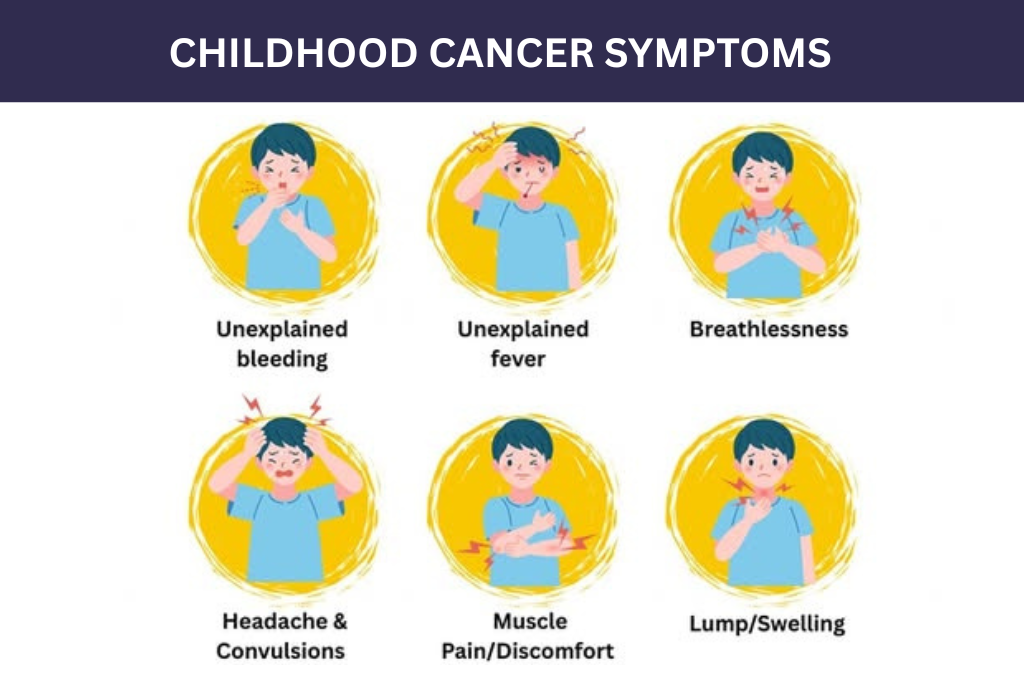
These small childhood cancer symptoms often show up slowly. Parents may think “It will be fine soon,” but sometimes checking early saves time and trouble.
Childhood Cancer Causes
Most parents ask, “Why did this happen? Did we do something wrong?”
No. Childhood cancer is not anyone’s mistake.
Many childhood cancer causes are not fully known. Doctors say they happen because of things inside the body that we cannot see. Sometimes the child is born with tiny changes in genes. Sometimes a small change happens while the child is growing. Sometimes infections or strong chemicals can be triggers, but these are rare.
Most families will never know the exact why. What doctors know is: The earlier we find it, the better we can treat it.
You will see childhood cancer causes mentioned twice here as needed.
How Doctors Diagnose Childhood Cancer
Diagnosis means figuring out what is happening inside the child’s body. Doctors may do:
- Blood tests
- Scans like MRI or CT
- Biopsy (taking a tiny piece to check under a microscope)
- Physical check of the body
These tests help doctors see the type of cancer, where it is, and how to treat it.
Childhood Cancer Treatments
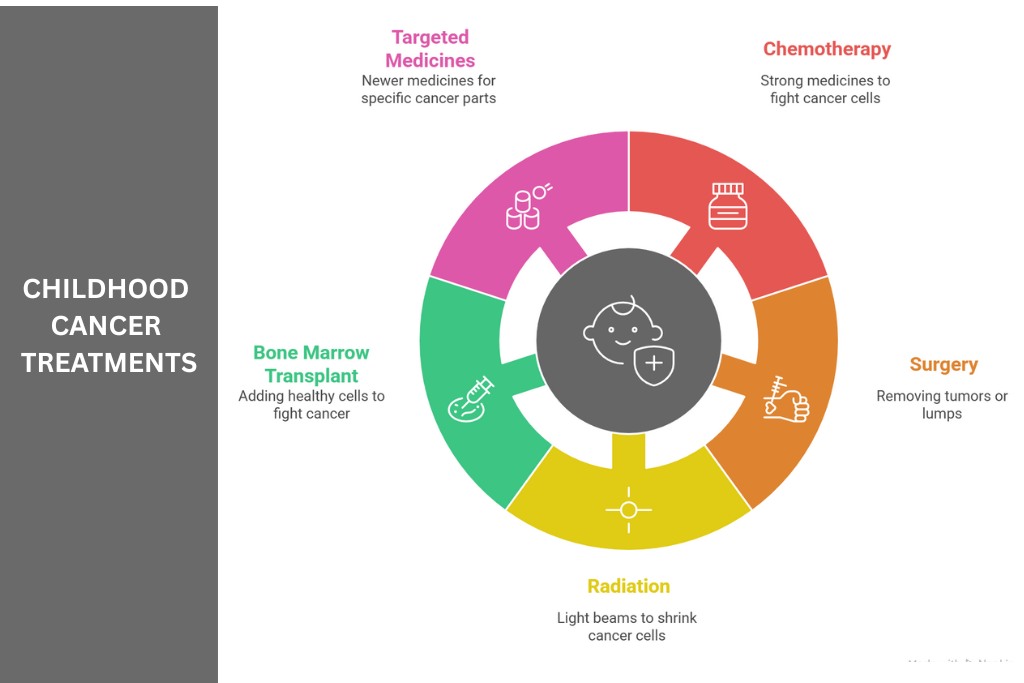
There are different childhood cancer treatments because every child and every cancer is different. Some kids need one treatment. Some need a mix of two or three. The main ones include:
1. Chemotherapy
Strong medicines that fight the bad cells.
2. Surgery
Removing the lump or tumor.
3. Radiation
Light beams that help shrink or kill cancer cells.
4. Bone Marrow Transplant
New healthy cells are added to the child’s body so they can fight again.
5. Targeted or Special Medicines
These are newer types of medicines that work on special parts of the cancer cells.
Hospitals try to make childhood cancer treatments as gentle as possible for kids. The goal is always to help them get back to school, friends, and normal life.
Childhood Cancer Prevention
Parents often ask if they can stop cancer from happening. Truth is, not all cancers can be stopped. Many happen without warning.
Still, some steps can help in childhood cancer prevention, such as:
- Keeping kids away from harmful smoke
- Eating clean food
- Clean surroundings
- Regular check-ups
- Watching for signs early
These are simple things that support a child’s body. But remember, even with all this, some cancers still happen. Families should not blame themselves.
We mention childhood cancer prevention twice in this blog as needed.
Life After Childhood Cancer
Many kids get better and live long, happy lives. Most of the childhood cancers are curable with early care. Children are tough, and their bodies recover quickly. They require families, affection, a quality doctor, and tolerance.
Little cancer survivors usually become courageous adults who motivate a great number of people.
When Should a Parent Call the Doctor?
- If a child has a fever for many days
- If they look pale or weak suddenly
- If they have lumps that don’t go away
- If pain stops them from walking or sleeping
- If anything feels “not normal” for too long
Parents know their kids better than anyone. If something feels wrong, checking early is always safer.
About Dr. Nandini Choudhury Hazarika
Dr. Nandini Choudhury Hazarika is a renowned pediatric oncologist and hematologist based in New Delhi, with 20 years of experience. She has done bone marrow transplants on more than 150 children, has treated numerous children with blood cancers, brain tumors, bone cancers, and rare cancers. She has trained in the leading hospitals in India as well as the USA and is a member of various professional institutions of pediatric oncology. Parents confide in her because of her care and experience as well as her commitment to the health of children.
Frequently Asked Questions (FAQs)
Q1. Are childhood cancers rare?
Yes, but they do happen. Early spotting helps a lot.
Q2. Do all fevers mean cancer?
No. Fever usually mean simple infections. Only long-lasting ones need checking.
Q3. Can childhood cancer be cured?
Many types can be treated very well when found early.
Q4. Are treatments painful?
Doctors use special methods to reduce pain as much as possible.
Q5. Can parents stop cancer from happening?
Not always. But keeping the child healthy and watching signs early helps.