
When parents are sitting opposite a doctor and the word ‘lymphoma’ is said, all the other things in the room turn far away. Your thoughts shift from trouble to perplexation:
What does this mean? How dangerous is it? Will my child get better?
These are quite normal thoughts. Childhood cancers are terrorising, but by knowing them, it is a little less daunting. We shall divide this down into small steps.
What Lymphoma Really Means
This is a network that exists in our body, keeping things in check. It traps infections, empties waste and displaces small armies, the white blood cells, to combat germs. Such soldiers are normally disciplined. They understand when to expand, when to cease and when to retire.
It is lymphoma when some of them lose the rules. They begin to multiply like somebody has turned the speed up and has forgotten to turn it off. This crowding occurs in the lymph nodes – the tiny bean-like structures that you might have felt in the neck or underarms when getting sick.
That is the rudimentary meaning of lymphoma. It isn’t your fault. It has nothing to do with your child. It is nothing but cells playing naughtily.
There are two big types:
Same family, different personalities.
Hodgkin’s Lymphoma — The One That Usually Appears in Teens
Hodgkin’s tends to show up in older kids—teenage years especially—but not very commonly in small children. The defining feature (and what helps doctors identify it) is a special weird-looking cell called the Reed–Sternberg cell. If this cell shows up under the microscope, that’s Hodgkin’s.
Parents usually tell me their child had:
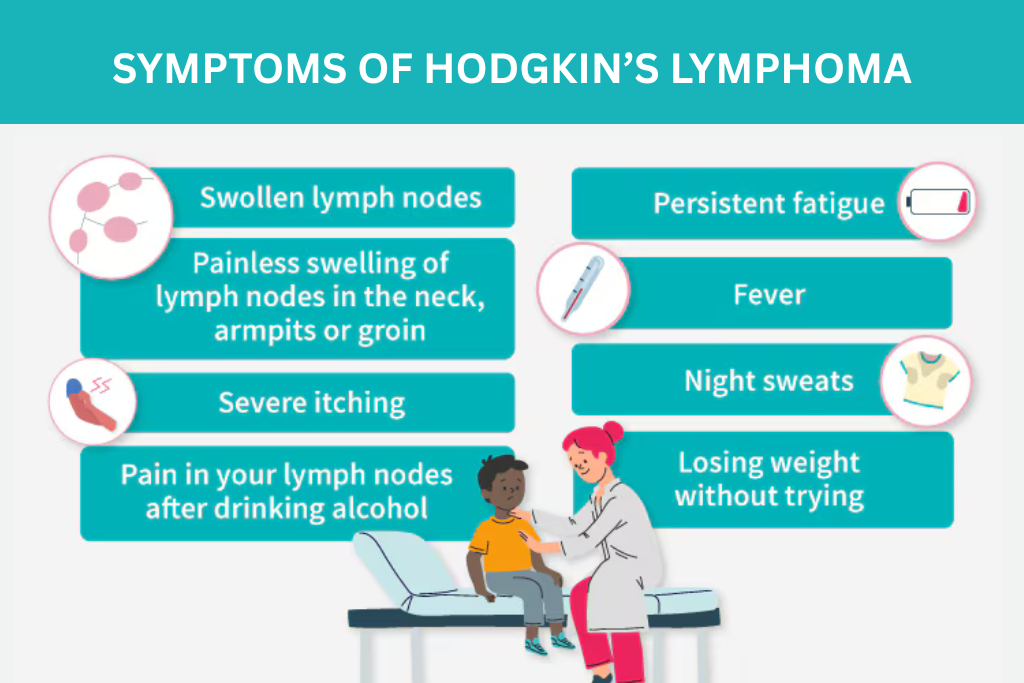
- A lump that didn’t hurt
- Tiredness that didn’t make sense
- Night sweats (sometimes enough to soak the T-shirt)
- Fevers that kept coming and going
- Weight loss even though nothing changed
- Skin itching that felt random
The comforting part is that Hodgkin’s responds extremely well to treatment. Most kids bounce back. Treatment can be chemotherapy, sometimes radiation, depending on how early it’s caught.
Non-Hodgkin’s Lymphoma — More Common in Younger Children
Non-Hodgkin’s is the type we see more often in smaller kids. This one can grow fast, which is why doctors don’t wait around once the diagnosis is confirmed.
It isn’t just one disease—there are several subtypes hiding under the same name. Some move quickly, some slowly, and they behave differently from case to case.
Children may show:
- Swollen nodes that don’t hurt
- Belly discomfort or swelling
- Trouble breathing or coughing without infection
- Feeling “full” after eating almost nothing
- Weakness, fever, weight loss
Chemotherapy is the main treatment, and yes, it works in the majority of cases. Kids are amazingly strong through it.
How the Hodgkin’s vs Non-Hodgkin’s Lymphoma Types Differ
Parents often think one is “better” or “worse”, but it’s not that simple. Both are treatable. Both have good outcomes with timely care.
Here’s the real difference:
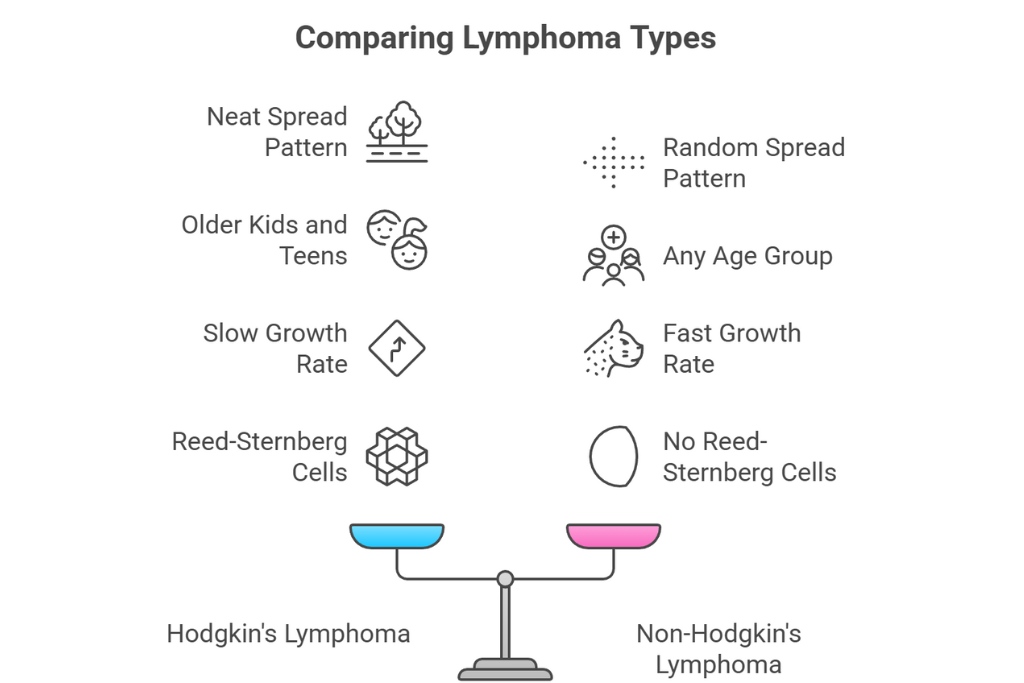
- Hodgkin’s spreads in a neat, step-by-step direction.
- Non-Hodgkin’s can appear anywhere and doesn’t follow neat rules.
- Hodgkin’s = older kids and teens
- Non-Hodgkin’s can happen at any age.
- Hodgkin’s grows slowly
- Non-Hodgkin’s grows faster
- Hodgkin’s has Reed-Sternberg cells.
- Non-Hodgkin’s doesn’t
And the part parents care about most:
More than 80% of children with either type recover when treated on time.
How Doctors Confirm the Type
The testing part often scares families, but it’s straightforward. Doctors usually do:
- A biopsy — a tiny piece of the swollen node examined under a microscope and IHC ( immunohistochemistry ) is crucial for diagnosis specific subtypes of Hodgkin’s and non Hodgkin’s lymphoma
- Blood tests
- CT, MRI, or PET scans to see if the disease has travelled and also assess the response to treatment.
Bone marrow biopsy is done to rule out whether bone marrow is involved by the disease or not ( staging purpose)
The biopsy is the main decider. Everything else helps figure out the stage and treatment plan.
How Treatment Usually Works
Treatment looks different for every child, but here’s the usual picture:
- Chemotherapy
This is the big one. It reaches the whole body and kills cancer cells wherever they’re hiding. - Radiation therapy
Used more in Hodgkin’s if a particular area needs extra help. - Bone marrow transplant
Only for cases where lymphoma is stubborn, comes back, or doesn’t respond properly.
The length of treatment can be anywhere between 6 months and 2 years. Some kids finish earlier; some need adjustments.
Hair falls, appetite dips, moods swing—these things happen, and they pass. Children recover surprisingly fast after treatment ends.
Getting Expert Care
Take no time when you notice any telltale signs in your child. Early diagnosis and late diagnosis vary by a huge margin. The quality services that your child deserves will be availed by the professional physicians like Dr Nandini Hazarika. She has been working in Madhukar Rainbow Children Hospital in Rainbow Nagar, Delhi, and Dr Nandini Hazarika Clinic in Saket. Her training at the top schools and her experience in paediatric oncology have helped her to help a variety of families cope with childhood cancer.
The reason behind this is that the awareness of the difference between Hodgkin and non-Hodgkin lymphoma would help parents to make informed decisions. The two are severe forms, but both are curable.
Remember the following: Hodgkins Lymphoma is slower and more prevalent among adolescents. Non-Hodgkin lymphomaHodgkin’s lymphoma is fast and can develop at any age in children.
Both of them react well to the treatment, and most of the children are cured. Communicate with a paediatric oncologist in case you are concerned about the health of a child. Dr Nandini Hazarika can be found at +91-96508 06846.
Frequently Asked Questions (FAQs)
Q1. Which one is more dangerous?
They are both treated quickly, and their success rates are also high. There is a slightly higher cure rate for Hodgkin, but Non-Hodgkin is also treated successfully among most children.
Q2. Can lymphoma spread?
Yes. Hodgkins comes in a chain fashion. The spread of Non-Hodgkin is more random. This is why it is necessary to stage tests prior to treatment.
Q3. How long does treatment last?
The majority of children are cured in 6 months to 2 years, based on the type and level.
Q4. Will my child’s hair come back?
Absolutely. The chemotherapy hair loss is temporary. It starts growing shortly after the discontinuation of treatment.
Q5. Who is the top paediatric lymphoma doctor in Delhi NCR?
Dr Nandini Choudhury Hazarika, a paediatric oncologist who works at Madhukar Rainbow Children Hospital (Delhi) and Dr Nandini Hazarika Clinic in Saket, is well known due to her experience in cancer care using bone marrow transplant.